Governance & Operating Model
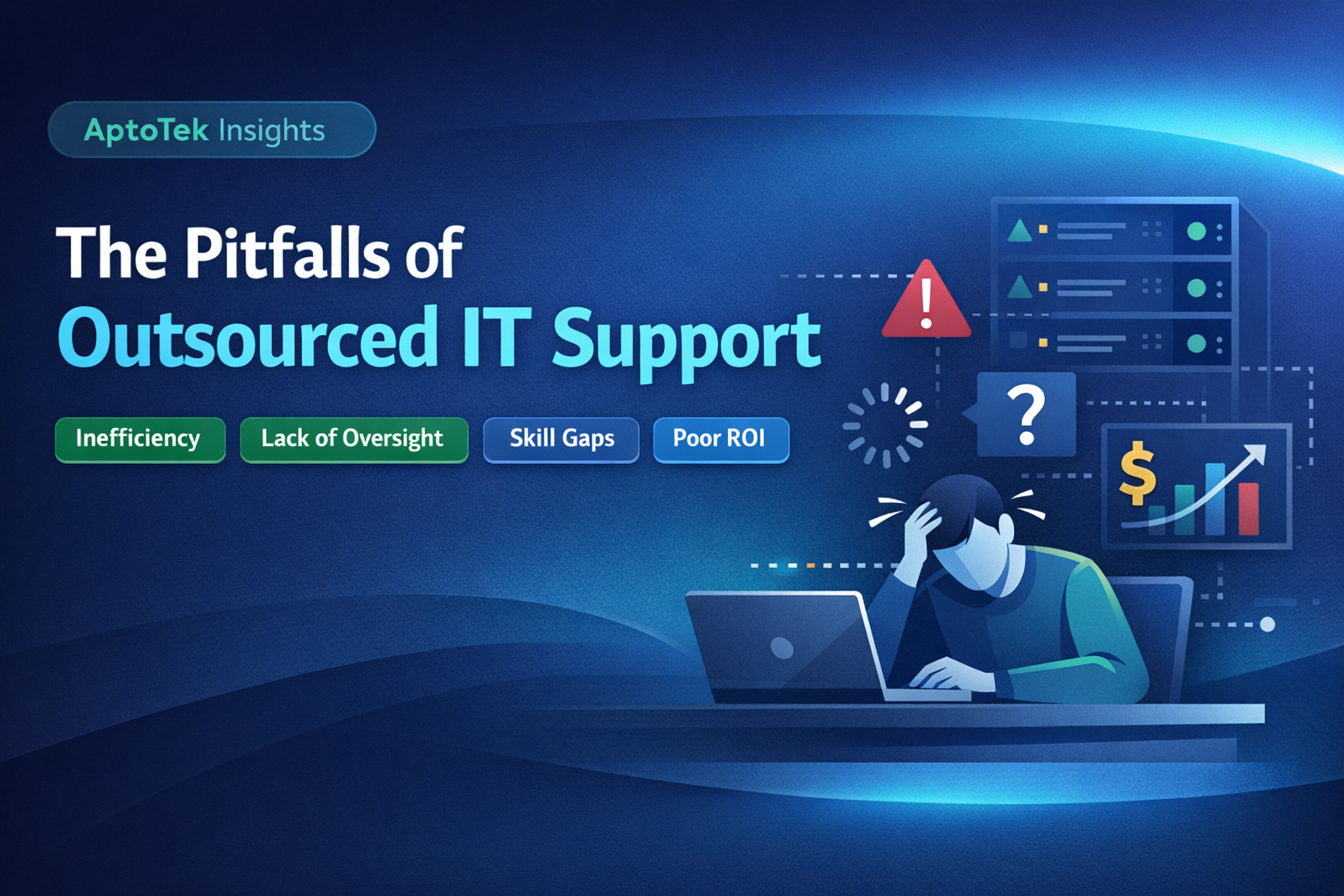
When Outsourced IT Support Optimizes for Tickets Instead of Outcomes
A single software installation should not consume half a day, multiple handoffs, and avoidable user frustration. For leadership, that is not a minor service hiccup. It is a control failure, a governance gap, and a hidden cost center.
Read time: ~8 min
Most executives do not lose sleep over a desktop software install. They should not have to. That is the point. Routine IT support work should be routine: predictable, efficient, documented, and completed by someone who knows what they are doing.
But in many outsourced support models, simple tasks turn into long chat sessions, repeated remote access attempts, unclear ownership, unnecessary escalations, and a user acting as the de facto project manager. The invoice may still look tidy. The operating reality is not.
The Real Issue Is Bigger Than One Bad Support Experience
Consider the pattern behind a common scenario: a user needs a standard tool installed, the support analyst struggles with remote access, basic install prompts create confusion, the work stalls, and the ticket is eventually handed to another team. The task does get completed. Eventually. But from a leadership perspective, that is not success. That is expensive drift disguised as service delivery.
What stands out is not just delay. It is the absence of operating discipline:
- No clear evidence of skill readiness for the technician performing the task.
- No strong triage to determine whether the assigned resource was appropriate.
- No time-to-value mindset for the business user waiting on access.
- No visible oversight during the support session.
- No practical mechanism for quality scoring beyond “ticket closed.”
What leadership sees
Tickets resolved, SLA dashboards, support volumes, and labor hours.
SLA compliance Ticket counts Hours loggedWhat the business experiences
Interruptions, delays, handoffs, unclear ownership, and productivity loss that rarely shows up on the vendor scorecard.
Lost time User friction ReworkWhy This Matters to the Business
Outsourced support is often sold on efficiency, scale, and standardized delivery. In practice, many organizations end up measuring what is easy instead of what matters. Ticket volume and hours worked are convenient. Business outcomes are harder. That is exactly why they matter more.
From a business perspective, poor support operating models create four predictable losses
- Productivity loss: Users stop doing value-added work while they wait, troubleshoot, explain context, or sit through repeated remote sessions.
- Delivery drag: Project timelines slip when access, tools, or dependencies are delayed by support inefficiency.
- Management blind spots: Leaders see “resolved” tickets, not the true effort, frustration, or quality concerns behind them.
- Budget leakage: Outsourcing spend appears controlled while avoidable labor waste accumulates across the enterprise.
The Leadership Problem: Accountability Without Visibility
Many outsourced arrangements create a dangerous illusion: because there is a vendor, there must be accountability. Not necessarily. Without the right controls, responsibility gets distributed across the provider, the client service owner, the user, and sometimes a second support team. Everyone touched the issue; nobody truly owned the outcome.
That is where leadership should pay attention. The core questions are not technical. They are managerial:
- Who owns first-time-right execution for routine support requests?
- Who validates that technicians are trained for the tasks they are assigned?
- Who reviews whether effort spent was reasonable for the work performed?
- Who captures user feedback in a way that affects provider performance?
- Who identifies repeat friction patterns and drives corrective action?
Weak model
“The ticket was worked for two hours and eventually completed.”
- Labor-centric
- Reactive
- Low transparency
- Little learning loop
Strong model
“The right technician completed the request quickly, securely, and with measurable user confidence.”
- Outcome-centric
- Governed
- Auditable
- Continuously improved
The Control and Oversight Gap
In too many support environments, control is confused with policy. Yes, the policy may say only Windows administrators can install software. That is reasonable. But policy alone does not ensure competent execution. Control requires a full chain: qualified staff, documented procedures, escalation paths, performance thresholds, and review mechanisms.
When those controls are weak, organizations see symptoms like these:
- Technicians who do not understand common installation flows or credential requirements.
- Users coaching the support analyst through basic steps.
- Multiple handoffs with no clear root-cause review.
- Tickets closed based on functional completion rather than quality of execution.
- No distinction between complex incidents and low-complexity routine tasks.
What Good Looks Like: A Better Operating Standard
For CIOs, IT leaders, and sourcing owners, the answer is not “bring everything back in-house.” The answer is to run outsourced support like a managed capability, not a black box.
A practical oversight framework
- Classify the work properly. Separate routine requests from specialist tasks. Do not assign a simple install to someone who is learning in real time.
- Measure efficiency, not just activity. Track expected effort by task type and flag exceptions when actual handling time materially exceeds the norm.
- Score quality at the ticket level. Include first-time-right completion, handoff rate, user disruption, and clarity of communication.
- Close the feedback loop. Give the business a structured way to report poor execution and connect that feedback to provider governance.
- Use trend reviews, not anecdotes. Look for repeated friction by technician group, vendor tower, request type, geography, or support process.
A 30/60/90-Day Improvement Path
First 30 days
- Identify top recurring support requests by volume.
- Define expected handling-time ranges for standard tasks.
- Review recent tickets for excessive handoffs or repeat contacts.
- Capture business-user feedback beyond CSAT smiley scores.
Days 31–60
- Introduce task-based quality reviews and exception reporting.
- Map skills to ticket categories and tighten assignment rules.
- Establish governance reviews with vendor leads and client owners.
- Document failure patterns and corrective actions.
Days 61–90
- Refine KPIs around outcome quality, effort variance, and rework.
- Implement knowledge transfer and quality gates for routine support work.
- Use audit-ready evidence for provider performance discussions.
- Tie renewals and service expansion to measurable service maturity.
Success indicators
- Lower average handling time for routine work
- Fewer avoidable escalations
- Higher first-contact resolution where appropriate
- Better trust from business stakeholders
How AptoTek Helps
AptoTek helps organizations fix the gap between outsourced IT activity and business outcomes. We do not treat support performance as a spreadsheet exercise. We treat it as an operating model problem that affects delivery, governance, user confidence, and spend discipline.
Our approach is outcome-first, not hour-first
- Service model assessment: We review support workflows, task categories, handoffs, and performance measures to identify where effort and accountability break down.
- Governance design: We help define clear oversight structures, escalation ownership, service reviews, and decision rights across internal teams and external providers.
- Quality gates and auditability: We establish measurable controls around routine support work so leaders can separate true complexity from avoidable inefficiency.
- Outcome-first staffing: We align the right skill level to the right work, reducing the costly pattern of over-escalation, under-training, and business-user disruption.
- Knowledge transfer and delivery integration: We make sure improvements are documented, repeatable, and embedded into daily operations rather than trapped in slide decks.
That means leaders get more than a vendor performance conversation. They get a practical roadmap to improve service quality, strengthen governance, and ensure support operations actually support the business.
Bottom Line
When outsourced IT support is measured mainly by tickets touched and hours consumed, the business ends up funding inefficiency without seeing it clearly. A delayed software install may look small, but it often reveals something larger: weak accountability, underdeveloped skills, poor oversight, and service metrics that reward motion instead of results.
High-performing organizations do not accept that as normal. They define what good looks like, measure against it, and hold providers to standards that reflect business value, not just operational noise. That is where AptoTek brings clarity: better governance, stronger delivery controls, smarter staffing alignment, and support models built around outcomes the business can actually feel.
© AptoTek. All rights reserved.